Collect.
Find emerging forms in published research and demonstrations.
Robotics. Research. Real work.
We assess advances in robotics, explore how machine capabilities will evolve, and help organisations decide where and how to put them to work.
From a sensor-equipped tool to an autonomous robot, we connect what a machine can do with the work that needs doing.

At the research frontier, the capability is still being invented. The task is to judge the ambition, the dependencies and the evidence that would make the claim stand up.
We examine emerging robotics: manipulation, actuation, tactile sensing, soft robotics and AI-enabled robot design. A promising component is a starting point. We ask what changes in the behaviour of the whole machine.
An assessment of the proposed advance, the capabilities it depends on, and the experiments needed to test it.
Framework: Robotics Evolution R&D Playbook
Illustrative capability analysis.
Independent external review for ARIA’s Robot Dexterity programme, examining ambitious research into the next generation of robot capabilities.
Read moreSoft bodies. Growing structures. Machines that fold, reconfigure or act together. The emerging diversity of robotics opens up new ways to think about difficult work.
Our research collects, collates and classifies emerging robot species. We study the forms being developed by researchers around the world, how they function, and the possibilities they open up.
“Species” is a way of making that diversity understandable: grouping robots by their bodies, behaviours and capabilities. The purpose is education—helping people recognise possibilities they might otherwise overlook, and distinguish demonstrated capabilities from future promise.
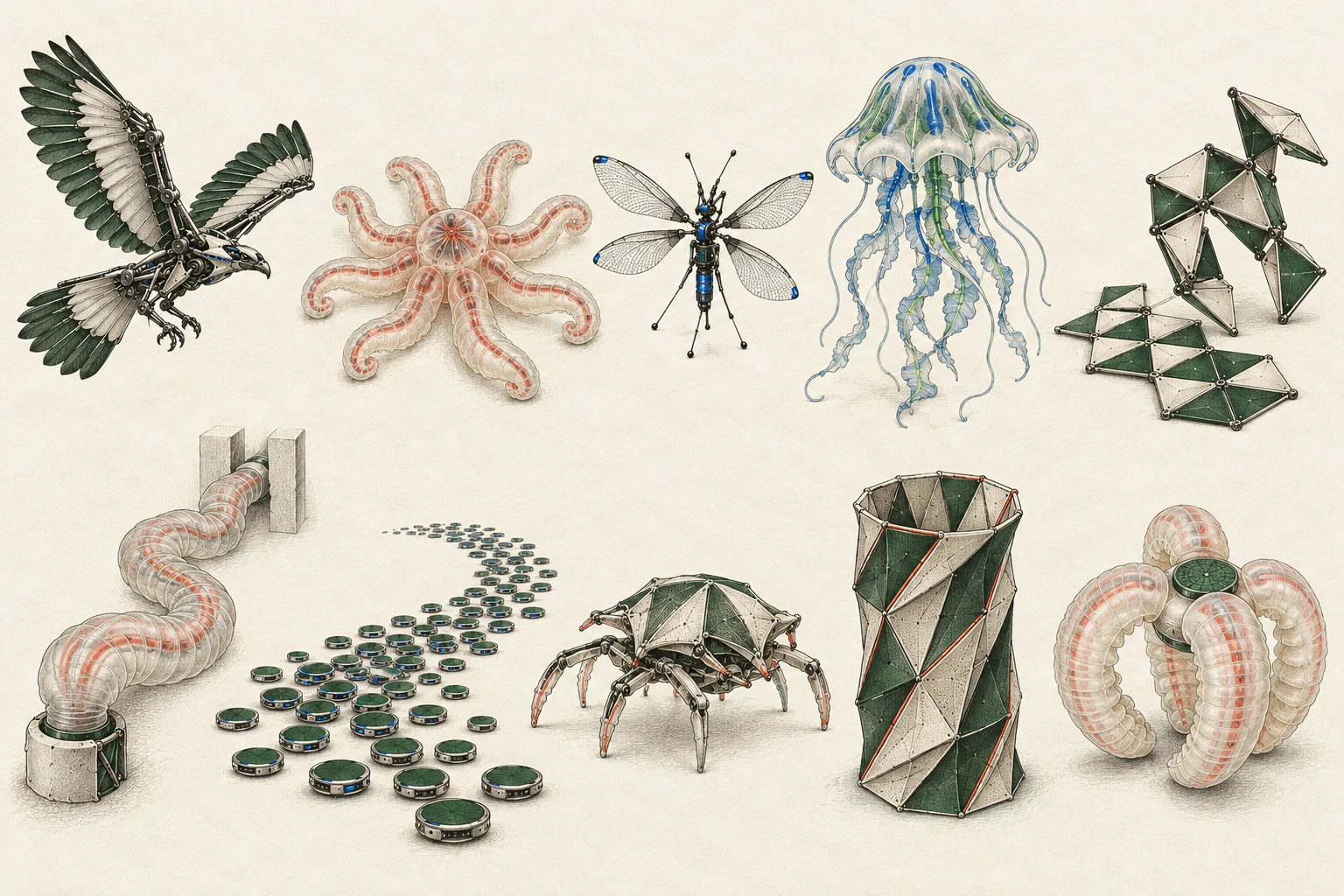
Find emerging forms in published research and demonstrations.
Bring together their capabilities, evidence and practical limits.
Make sense of the species—and the kinds of work they might help with.
Our research examines 15 fundamental functions shared across robots. Following their development helps us understand how capabilities change, combine and find expression in different species.
Sense · Move
Manipulate · Adapt
Examples of the functional lens
What could a machine do differently—and what would need to develop together to make that possible?
Which work could change? Which responses are worth pursuing? What would it take to bring them into everyday use?
We work through your operations with the people who know them. We identify recurring difficulties, develop use cases, compare responses and examine readiness. The result is a portfolio of promising opportunities, with a reason to pursue each and a clear next investigation.
A portfolio may include better tooling, digital support, fixed automation and adaptable robots. The combination follows the work.
Map the task and what makes it difficult.
Define what could change and for whom.
Consider different ways to do the work.
Prioritise the next investigations.
One task can contain several different challenges. These twelve families help make the requirements visible, so that useful responses can be compared.
What contact can the item tolerate without damage?
How is the item supported while preserving its shape and access?
What must remain clean or ready for the next operation?
How is the item located, referenced and presented?
What geometry must be maintained as parts are joined?
How can the item be secured, then released cleanly?
What must be true when work passes between people or machines?
How do we know which item, history and setup apply?
What feedback and evidence establish acceptable work?
Which pressure, seal and heat-transfer conditions matter?
What happens when the operation does not go to plan?
Can the work be seen, reached and changed over reliably?
Six response choices. They can combine: a better fixture may be part of the robotics answer.
Change how the work is set up.
Support decisions and information flow.
Automate a well-defined operation.
Combine human judgement and machine assistance.
Consider machines that can accommodate change.
Make an explicit decision to hold or close an option.
The numbers identify alternatives. They do not rank technological sophistication.
Challenge Families and the Six Rs were developed and refined through our workshop work with the National Robotarium.
A machine may perform the task and still be difficult to adopt. Our 21-element readiness assessment brings supply, demand and governance into the same decision.
Capability, integration, suppliers and ongoing support.
Operational value, people, workflows and the ability to absorb change.
Ownership, funding, risk, assurance and accepted evidence.
A working portfolio that connects each opportunity to its response choices, evidence gaps and next investigation.
Illustrative portfolio · Three example opportunities
Reach difficult places. Bring back useful evidence.
Can the evidence support a maintenance decision and enter the asset record?
Define the evidence standard with the people who accept it.
Keep control of contact, variation and alignment.
What forces, variation and tolerances must the system accommodate?
Characterise the task and test the difficult cases.
Make the whole journey work, including its exceptions.
How do space, interfaces and changing demand affect the choice?
Map journeys, hand-offs and recovery from interrupted transfers.
The work, the value and the boundaries.
Alternatives, combinations and trade-offs.
The gaps that affect the decision.
What to test, who owns it and what follows.
These examples demonstrate the method; they are not client findings or recommendations.
Engineering, strategy and the cyber-physical world
The thread through Bill Murray’s career has been a question: what does technology make possible, and what must organisations become capable of doing to put it to work?

He began as a mechanical engineer at Arup, investigating the behaviour of complex physical systems. He later became a vice president at CSC, founded and built Differentis, and researched digital platforms, software engineering, ecosystems and digital twins at DXC’s Leading Edge Forum. Across those roles, the work moved between technical architecture, business strategy and the realities of organisational change.
Those strands now converge around cyber-physical systems and smart machines. Bill was recognised as one of six founding architects of the UK Cyber-Physical Infrastructure vision. More recently he has contributed to smart-machine strategy, evaluated frontier robotics proposals for ARIA and worked with the National Robotarium on robotics opportunities, readiness and adoption.
Westleigh Warwick brings together the ideas, frameworks, experience and unanswered questions arising from that continuing work.
The National Robotarium work provides a practical benchmark across organisations, sectors and operating conditions. Our frontier review and evolution research bring the changing capabilities of machines into that picture.
External review of concept papers, seed applications and full proposals for the Robot Dexterity programme. This work examines speculative research, its physical capability claims and the evidence proposed to establish them.
Research into how robot functions develop and combine, alongside the collection, collation and classification of emerging robot species. A foundation for frontier assessment, education and the longer view of machine capability.
Robotics Readiness Reviews and workshops with operating teams: examining work, developing opportunities and considering the route into use. Experience spans large manufacturers, infrastructure operators, retailers, smaller businesses and mixed sector groups.
Different materials, environments and responsibilities. A broader view of what makes adoption work.
Production, assembly and precision work
Complex products and demanding assurance
Products, processes and handling
Stock, stores and logistics
Infrastructure, inspection and maintenance
Assets, access and work at sea
Variable environments and living materials
Flexible materials and varied handling
Operational demands and human judgement